

Understanding Intensive Outpatient Programs Within New Jersey’s Addiction Treatment Continuum
Choosing the appropriate level of care for substance use treatment in New Jersey requires clinical evaluation, risk assessment, and a clear understanding of how addiction treatment in New Jersey is structured under state regulation and nationally recognized clinical standards.
An Intensive Outpatient Program (IOP) is one level within the addiction treatment continuum defined by the American Society of Addiction Medicine (ASAM). In New Jersey, IOP is most often used as a step-down level of care for individuals who have achieved medical stability and no longer require 24-hour supervision, allowing continued therapeutic engagement alongside daily responsibilities.
At Rolling Hills Recovery Center, treatment planning prioritizes safety, medical necessity, and long-term recovery outcomes. While Rolling Hills does not operate or advertise an Intensive Outpatient Program, clinical teams routinely evaluate whether outpatient care may be appropriate following detoxification or residential treatment. These evaluations are informed by ASAM placement criteria, New Jersey Department of Human Services (NJDHS) regulations, and direct clinical experience treating moderate to severe substance use disorders.
This article explains how Intensive Outpatient Programs function within New Jersey’s treatment system, when they may be clinically appropriate, and when higher levels of care are medically indicated, helping individuals and families make informed decisions that prioritize safety and continuity of care.
What Is an Intensive Outpatient Program (IOP)?
An Intensive Outpatient Program (IOP) is a defined level of substance use treatment within the American Society of Addiction Medicine (ASAM) Criteria, categorized as Level 2.1 care. IOP is designed for individuals who are medically stable, no longer experiencing acute withdrawal symptoms, and capable of managing daily responsibilities outside of treatment hours.
Under ASAM guidelines, Level 2.1 programs typically involve nine to nineteen hours of structured clinical programming per week, delivered across multiple days. This level of intensity provides meaningful therapeutic support while assuming a degree of independence that would be unsafe for individuals who still require medical monitoring, behavioral containment, or environmental protection.
In New Jersey, licensed IOPs operate under behavioral health regulations overseen by the New Jersey Department of Human Services (NJDHS). These standards govern clinical staffing, documentation, treatment planning, and supervision to ensure outpatient care remains structured and clinically accountable.
IOP programming generally emphasizes group-based therapy as the primary modality, supported by individual counseling, psychoeducation, and coordination with psychiatric or medication providers when clinically indicated. Core objectives include relapse prevention planning, emotional regulation, and reinforcement of recovery-oriented behaviors.
Importantly, IOP is not intended as an entry point for individuals with moderate to severe substance use disorders who have not yet achieved medical or psychological stabilization. For this reason, IOP is most appropriately positioned after completion of medical detoxification or residential treatment, where stabilization has already occurred.
At Rolling Hills Recovery Center, clinical teams regularly assess whether individuals transitioning from higher levels of care are appropriate candidates for outpatient services. Although IOP is not offered onsite, treatment planning includes evaluating whether structured outpatient programming aligns with clinical progress, stability, and ongoing risk assessment rather than convenience or cost.
For additional context on how therapeutic intensity changes across levels of care, see our page about evidence-based addiction therapy.
Where Intensive Outpatient Programs Fit Within New Jersey’s Levels of Care
Addiction treatment in New Jersey is structured around a continuum of care model designed to match treatment intensity with clinical need. This framework is defined nationally by the American Society of Addiction Medicine (ASAM) and used by New Jersey regulators, licensed treatment providers, and insurance reviewers to determine appropriate placement based on medical stability, psychiatric risk, and functional ability.
Within this continuum, Intensive Outpatient Programs (IOP) occupy a defined step-down role, positioned between partial hospitalization and standard outpatient care. Understanding where IOP fits relative to other levels of care is essential for making safe, clinically appropriate treatment decisions.
Comparison of Common Addiction Treatment Levels of Care
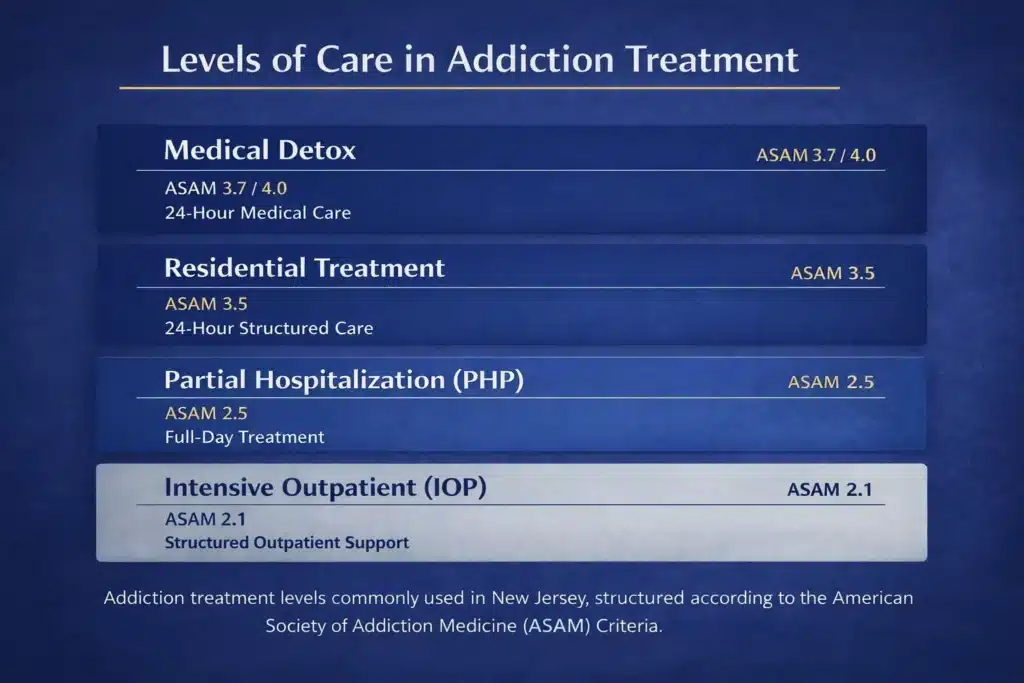
This comparison illustrates a key clinical principle: Intensive Outpatient Programs are not intended to replace medical detox, residential treatment, or partial hospitalization when those levels of care are medically indicated. IOP assumes that acute withdrawal risks have been resolved, psychiatric symptoms are stable, and individuals are capable of maintaining safety outside of a controlled environment.
At Rolling Hills Recovery Center, placement decisions are evaluated within this continuum to ensure that transitions from higher levels of care support recovery rather than undermine it through premature step-down. While IOP services are not offered onsite, treatment planning frequently includes determining whether structured outpatient care aligns with an individual’s clinical progress, risk profile, and long-term recovery needs.
Who Intensive Outpatient Programs Are Clinically Appropriate For
Intensive Outpatient Programs are designed for individuals who have achieved a foundational level of medical and psychological stability but still benefit from structured therapeutic support. Clinical appropriateness is determined by risk assessment rather than convenience, scheduling preference, or insurance considerations.
In New Jersey, placement into IOP is typically considered only after higher levels of care have addressed acute risks. Individuals entering outpatient treatment must be capable of maintaining safety between sessions and applying recovery skills in real-world environments without continuous supervision.
Clinical Indicators That May Support IOP Placement
IOP may be appropriate when an individual has completed medical detoxification or residential treatment, is no longer experiencing acute withdrawal symptoms, demonstrates stability in mood and behavior, has a living environment that supports recovery, can attend scheduled programming reliably, and does not require 24-hour monitoring for safety or psychiatric symptoms.
When IOP Is Not Clinically Appropriate
Outpatient intensity alone is often insufficient for individuals with unresolved medical or psychiatric risks. IOP is generally not appropriate for individuals experiencing moderate to severe withdrawal symptoms, unmanaged co-occurring mental health conditions, unstable housing, repeated relapse following outpatient attempts, or inability to maintain safety between sessions.
Clinical Judgment and Ethical Placement Decisions
Appropriate use of IOP relies on ongoing clinical judgment rather than static criteria. Risk profiles can change over time, and treatment intensity should adjust accordingly. At Rolling Hills Recovery Center, readiness for outpatient care is evaluated through a comprehensive medical review, a psychiatric assessment, and observed clinical progress during higher levels of treatment. While IOP services are not offered onsite, determining whether outpatient care aligns with an individual’s stability and recovery trajectory is a routine part of discharge and transition planning.
What Intensive Outpatient Programs in New Jersey Typically Include
Intensive Outpatient Programs in New Jersey are structured to deliver clinically meaningful treatment while allowing individuals to reside outside of a controlled setting. While program models vary by provider, licensed IOPs operate within defined regulatory and clinical expectations intended to ensure consistency, safety, and therapeutic integrity.
Programs offering outpatient addiction treatment must comply with standards established by the New Jersey Department of Human Services (NJDHS), which govern staffing credentials, treatment planning, documentation, and clinical supervision. These requirements exist to prevent outpatient care from becoming informal or inadequately monitored.

Core Therapeutic Structure
IOP programming is typically organized around group-based therapy as the primary clinical modality. Most programs also incorporate individual therapy sessions and psychoeducational components focused on relapse prevention planning, emotional regulation, stress management, and understanding the neurobiology of addiction.
Treatment approaches across levels of care are described in evidence-based addiction therapy.
Medical and Psychiatric Coordination
Although IOP does not provide 24-hour medical oversight, reputable programs coordinate care with external medical and psychiatric providers when clinically indicated. For individuals utilizing medication-assisted treatment, outpatient coordination supports continuity and adherence but does not replace medical stabilization services.
Accountability and Clinical Monitoring
Structure and accountability are essential components of effective outpatient treatment. IOP programs typically require consistent attendance, participation in scheduled sessions, and engagement with treatment planning. Clinical teams monitor progress through documented reviews and communication with referring providers when appropriate.
Role of Family and External Supports
Many IOPs encourage involvement from family members or external supports when appropriate. Family education can reinforce treatment goals and reduce environmental risk factors, while outpatient success still depends on stability and responsibility between sessions.
At Rolling Hills Recovery Center, these considerations are evaluated during discharge and transition planning following higher levels of care. Although IOP services are not offered onsite, assessing whether the outpatient structure aligns with clinical progress and stability remains a critical component of treatment planning.
Alcohol Use Disorder and the Limitations of Intensive Outpatient Care
Alcohol use disorder presents unique medical and neurological risks that often exceed the scope of outpatient treatment alone. While Intensive Outpatient Programs can support ongoing recovery, they are not designed to manage acute withdrawal, medical instability, or the early stages of alcohol cessation when complications may occur.
Clinical guidance used in New Jersey and nationally recognizes that alcohol withdrawal can involve serious risks, including seizures, cardiovascular instability, and delirium tremens. These risks require medical monitoring and, in many cases, inpatient stabilization before outpatient care can be safely considered.
Why Alcohol Withdrawal Requires Medical Stabilization
Unlike many substances, alcohol withdrawal affects multiple body systems simultaneously. Changes in brain chemistry, blood pressure regulation, and autonomic nervous system function can create unpredictable and potentially life-threatening symptoms during early sobriety.
Clinical guidance on alcohol withdrawal risk is supported by the National Institute on Alcohol Abuse and Alcoholism (NIAAA), which identifies alcohol withdrawal as a potentially life-threatening condition that often requires medical oversight rather than outpatient management alone.
Because Intensive Outpatient Programs do not provide 24-hour medical supervision, they are not appropriate for individuals who remain at risk for withdrawal complications. In these cases, medical detoxification allows clinicians to monitor vital signs and manage symptoms safely.
Post-Acute Withdrawal and Early Relapse Risk
Even after acute withdrawal resolves, individuals recovering from alcohol dependence may experience post-acute withdrawal symptoms (PAWS), including sleep disruption, mood instability, cognitive fog, and heightened stress sensitivity. These symptoms can increase relapse risk during early recovery.
IOP can support behavioral and psychological aspects of recovery, while effectiveness depends on whether medical stabilization and coping capacity are already in place.
Clinical Indicators That Higher Levels of Care May Be Required
IOP should not be used as a substitute for detoxification or residential treatment when medical or psychiatric risks remain elevated. Indicators that higher levels of care may still be necessary include:
• History of severe or complicated alcohol withdrawal
• Ongoing medical conditions affected by alcohol use
• Co-occurring psychiatric disorders requiring stabilization
• Repeated relapse following outpatient attempts
• Inability to maintain safety between treatment sessions
In these situations, attempting outpatient care prematurely can compromise recovery and delay appropriate treatment.
How Rolling Hills Recovery Center Evaluates Readiness for Outpatient Care
Determining whether an individual is ready for outpatient treatment requires more than meeting minimum stability criteria. Appropriate placement depends on medical safety, psychological readiness, and the ability to maintain recovery between sessions without continuous supervision.
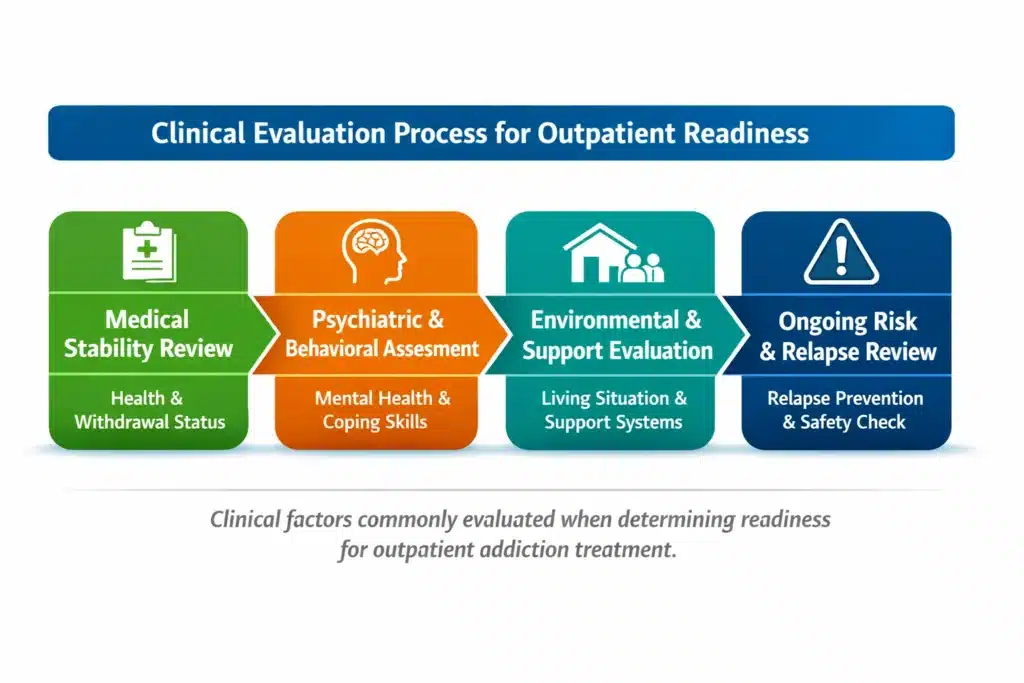
At Rolling Hills Recovery Center, readiness for outpatient care is evaluated through a structured clinical process designed to support safe transitions from higher levels of care. While Intensive Outpatient Programs are not offered onsite, assessing whether the outpatient structure aligns with clinical progress and risk profile is a core component of treatment planning.
Medical and Psychiatric Stability Assessment
Readiness for outpatient care begins with confirmation of medical stability, including withdrawal history, physical health status, medication needs, and conditions requiring monitoring. Psychiatric evaluation focuses on mood stability, impulse control, and co-occurring mental health conditions that affect safety or engagement.
Behavioral Readiness and Treatment Engagement
Outpatient care assumes the ability to apply coping skills outside of structured settings. Clinical teams evaluate attendance consistency, engagement in therapy, insight into relapse risk, and willingness to participate in ongoing treatment.
Environmental Stability and Support Systems
A stable living environment is essential for outpatient success. Evaluations include housing safety, exposure to substances, transportation reliability, and access to supportive relationships.
Ongoing Risk Assessment and Step-Down Timing
Readiness for outpatient care is revisited as progress occurs. Ethical placement prioritizes sustained recovery over rapid discharge, ensuring outpatient referrals support stability rather than increase relapse risk.
Transitioning From Residential Treatment to Intensive Outpatient Care
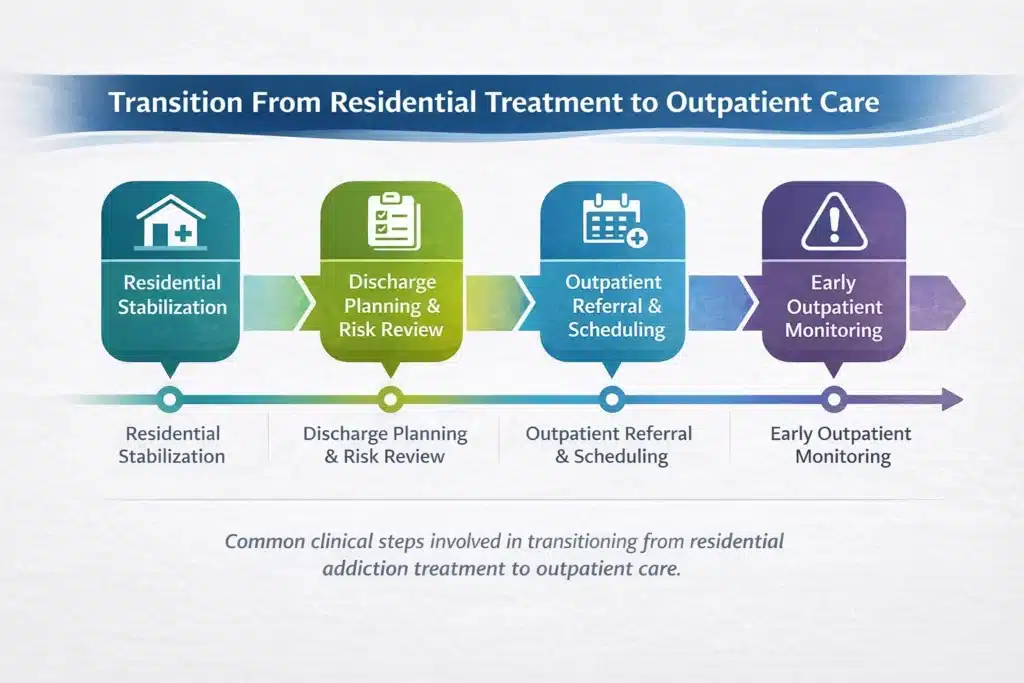
A successful transition from residential treatment to outpatient care is a planned, clinically sequenced process designed to maintain stability while gradually increasing independence. For individuals who have completed detoxification and residential treatment, Intensive Outpatient Programs can serve as a structured step-down when readiness criteria are met.
In New Jersey, step-down planning emphasizes continuity of care. Transitioning too quickly or without adequate support can increase relapse risk, while delaying step-down unnecessarily can interfere with reintegration into daily responsibilities.
Discharge Planning and Clinical Coordination
Effective transitions begin with structured discharge planning, including review of progress, identification of ongoing risks, and coordination with outpatient providers to maintain therapeutic momentum.
Early Outpatient Monitoring and Support
The initial weeks following residential treatment represent a period of increased vulnerability. Structured outpatient care helps individuals apply coping strategies in real-world settings while maintaining clinical accountability. When challenges arise, timely adjustments in treatment intensity can prevent relapse.
Role of Family and External Supports During Transition
Family involvement and external supports may reinforce boundaries and recovery goals during step-down, while outpatient success depends on individual stability between sessions.
At Rolling Hills Recovery Center, transition planning is integrated into residential treatment. While IOP is not offered onsite, clinical teams coordinate outpatient referrals and evaluate step-down timing to support continuity of care.
Insurance Coverage and Access to Intensive Outpatient Care in New Jersey
Access to Intensive Outpatient Programs in New Jersey is influenced by insurance coverage, authorization requirements, and clinical documentation. Coverage decisions are typically based on medical necessity rather than program preference.
Medical Necessity and Authorization Considerations
Coverage for IOP generally requires documentation demonstrating readiness for outpatient intensity, including evidence of medical stability, psychiatric assessment results, treatment history, and progress achieved during detoxification or residential care.
Role of Clinical Documentation and Care Coordination
Clear clinical documentation supports approval for outpatient services. Treatment summaries, risk assessments, and discharge plans help demonstrate readiness and justify continued clinical involvement.
Timing and Access Considerations
Provider availability and scheduling capacity can affect outpatient access. Early planning helps minimize gaps in care following residential discharge.
Choosing the Right Level of Care for Recovery in New Jersey
Intensive Outpatient Programs can play an important role in addiction treatment when used at the appropriate time and for the right clinical reasons. As part of a broader continuum of care, IOP offers structured therapeutic support while allowing individuals to begin reintegrating into daily responsibilities.
Effective treatment planning depends on evaluation of medical stability, psychiatric risk, environmental safety, and treatment history. Higher levels of care, such as medical detoxification and residential treatment, may be necessary before outpatient services can be considered safely, particularly for individuals with alcohol use disorder or complex clinical needs.
At Rolling Hills Recovery Center, treatment decisions are guided by safety, medical necessity, and long-term recovery outcomes. While Intensive Outpatient Programs are not offered onsite, clinical teams evaluate readiness for outpatient care and coordinate appropriate next-step referrals following detoxification or residential treatment.